Metamaterials Research
Project Overview
This research was conducted within the Institute for Future Technologies (IFT) at De Vinci. IFT describes itself as a lab studio embedded in education, where students and researchers explore new forms of inquiry at the intersection of technology, human experience, and the natural world.
I explored how architected materials could be designed to absorb shocks by controlling their geometry rather than relying on a solid material alone. The project focused on two complementary lattice approaches: hybrid TPMS structures and re-entrant honeycombs.
Generative Design
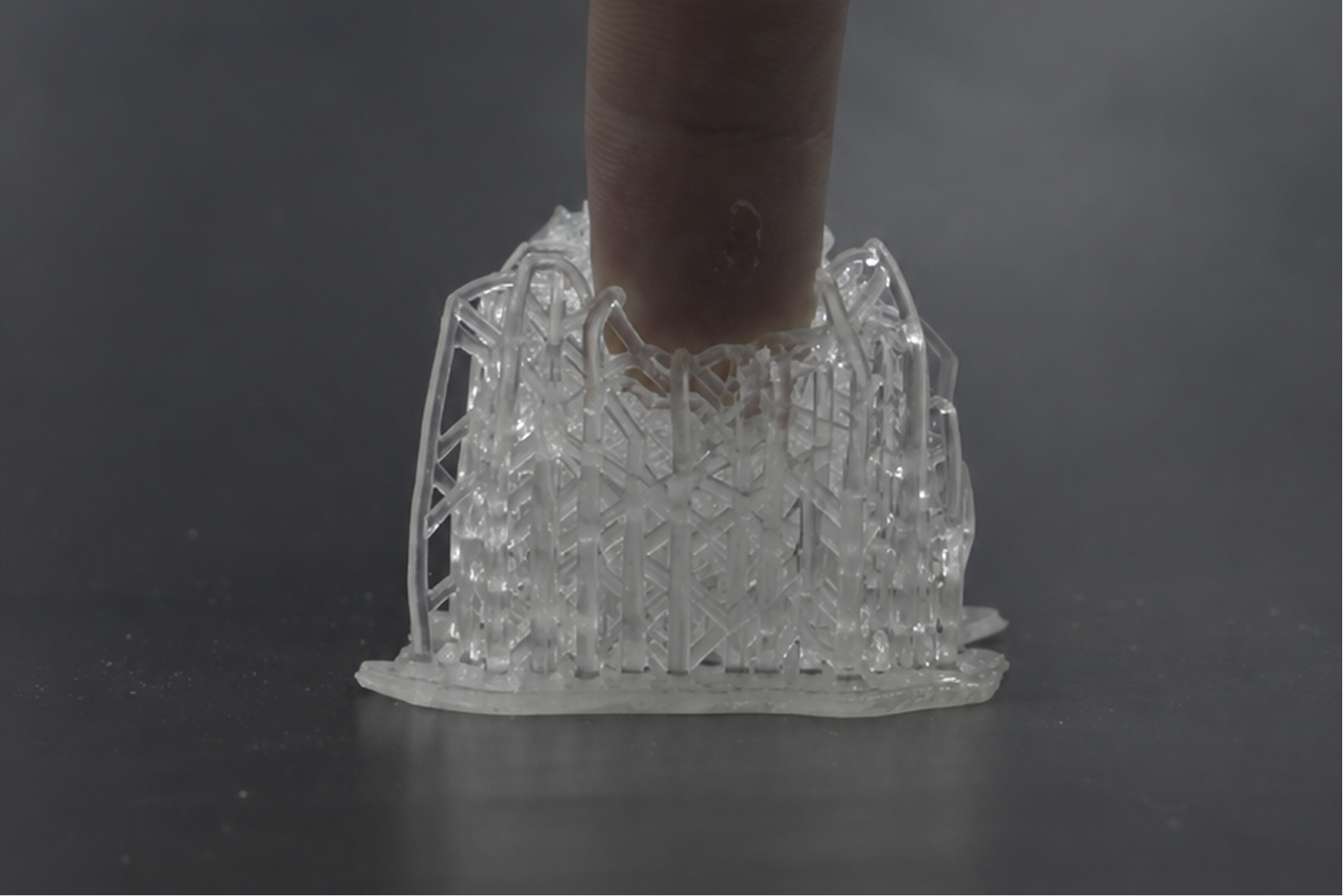
Using PicoGK, a voxel-based geometry kernel for C#, I built a procedural workflow to generate and vary the structures. One design track explored hybrid TPMS geometries combining a Schwarz network with Diamond sheet surfaces. The other investigated re-entrant honeycomb lattices, whose geometry can produce auxetic behavior and distinctive deformation under compression.
Across both approaches, I studied how geometric parameters shape stiffness, deformation, and energy absorption, with the goal of finding structures suited to impact and shock mitigation.
Prototyping and Validation
I first manufactured the geometries on a Formlabs Fuse 1+ using SLS Nylon 12. These prints helped validate the designs and their manufacturability. I then produced the functional test samples in TPU using SLS, to investigate the response of a more flexible material under compression and impact.
Potential Applications
The longer-term application areas I considered were protective or bullet-resistant jacket components, cushioning for beds and pillows, and energy-absorbing elements in running shoes. These were design targets for exploring the potential of the structures, rather than finished products.